
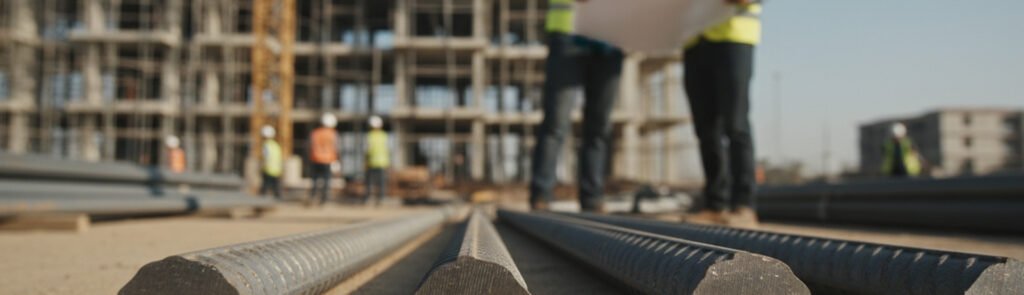
In any reinforced concrete structure, steel carries the tensile load, while concrete handles compression. This is why choosing the correct TMT bar grade for construction becomes one of the most important structural decisions in a building project.
Many homeowners and even some contractors assume that the highest grade is always the best option, but structural engineering does not work that way. The right grade depends on factors such as load distribution, seismic requirements, structural design, and the type of building.
Understanding the various TMT bar grades in India helps builders and engineers choose the most suitable reinforcement for safe and durable construction.
What Does a TMT Bar Grade Indicate?
TMT bar grades are classified based on their yield strength, which refers to the stress level at which the steel begins to deform permanently. Yield strength is measured in megapascals (MPa).
For example:
- Fe415 – Yield strength of 415 MPa
- Fe500 – Yield strength of 500 MPa
- Fe550 – Yield strength of 550 MPa
- Fe600 – Yield strength of 600 MPa
Higher yield strength means the steel bar can withstand greater stress before deforming. However, structural performance also depends on ductility, bendability, weldability, and fatigue resistance, which are critical in reinforced concrete applications.
Common TMT Bar Grades Used in India
Fe415 Grade
Fe415 bars offer high ductility and flexibility, making them suitable for structures that require better energy absorption.
They are commonly used for:
- Residential housing
- Small commercial structures
- Seismic zone constructions
Their higher elongation properties make them capable of handling dynamic stresses such as earthquakes or vibrations.
Fe500 Grade
Fe500 is currently the most widely used TMT bar grade for construction in India. It provides an optimal balance between strength and ductility.
Typical applications include:
-
- Residential buildings
-
- Multi-storey apartments
-
- Commercial complexes
Due to its structural efficiency and durability, many engineers consider Fe500 the best TMT bar grade for house construction.
Fe550 Grade
Fe550 bars are used in structures requiring higher load-bearing capacity.
They are typically preferred in:
-
- High-rise buildings
-
- Infrastructure projects
-
- Heavy structural foundations
These bars provide greater strength but slightly reduced ductility compared to lower grades.
Fe600 Grade
Fe600 is a high-strength reinforcement steel used mainly in specialised engineering applications where structural loads are significantly higher.
Typical uses include:
-
- Bridges and flyovers
-
- Industrial structures
-
- Mega infrastructure projects
Because of their strength characteristics, these bars are usually used under carefully engineered structural designs.
Factors to Consider When Selecting a TMT Bar Grade
Choosing the right reinforcement steel involves evaluating several structural parameters.
Structural Load
Buildings with higher load requirements, such as multi-storey or infrastructure projects, require higher yield strength grades.
Structural Design
Engineers calculate reinforcement requirements using structural analysis and load distribution models, which determine the exact grade required for beams, columns, and slabs.
Seismic Resistance
In earthquake-prone areas, reinforcement steel with good ductility and elongation properties is preferred so that structures can absorb energy without brittle failure.
Construction Type
Different structures require different reinforcement strategies:
-
- Residential houses
-
- Commercial buildings
-
- Infrastructure projects
This is why selecting the best TMT bar grade for house construction should always be guided by structural design rather than assumptions.
Conclusion
Choosing the right TMT bar grade for construction is essential for ensuring structural strength, safety, and long-term durability. Grades such as Fe415, Fe500, Fe550, and Fe600 serve different structural requirements, and the final selection should always be based on engineering design.
At the same time, modern construction must also consider environmental responsibility. By using renewable energy in steel manufacturing, AMBA Shakti Tricore TMT bars provide the same high-quality reinforcement while significantly lowering the carbon footprint of construction, supporting the future of sustainable and responsible building practices.