
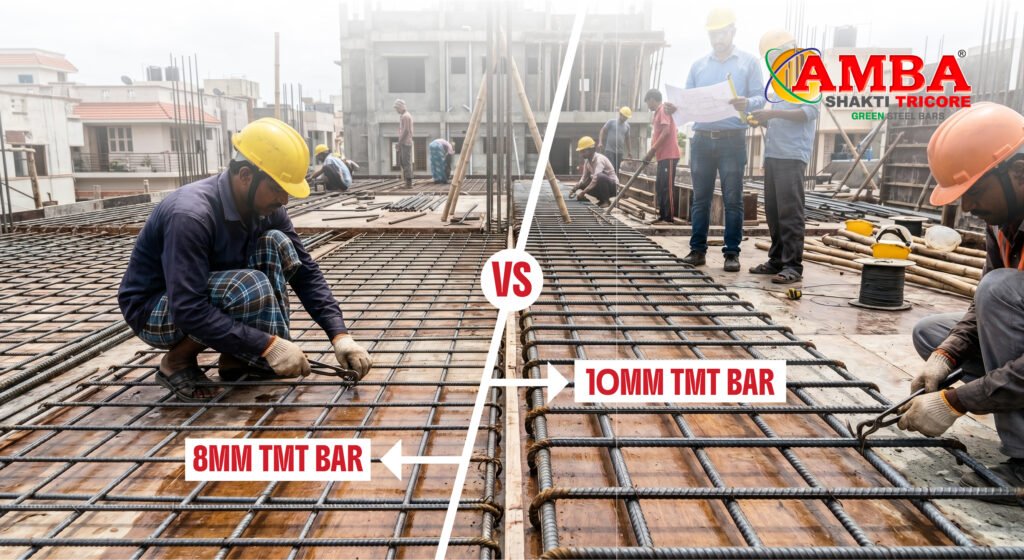
A roof is the surface that silently carries weight, weather, and time. And somewhere within that structure lies a decision many overlook: 8mm vs 10mm TMT Bar.
It’s a small technical choice, but one that directly influences how your roof performs over the years.
Let’s approach this differently. Instead of asking which is “better,” it’s more useful to understand where each fits. The discussion around 8mm vs 10mm TMT Bar is less about comparison and more about purpose. Every well-built slab uses a combination of reinforcements, each designed to handle a specific kind of stress.
8mm bars are typically used as distribution steel. In a TMT bar for roof slab setup, they help in controlling cracks, distributing load evenly, and maintaining structural balance. They are lighter, more flexible, and easier to place, making them ideal for secondary reinforcement.
10mm bars, on the other hand, serve as the strength. When selecting the best steel size for roof construction, these bars are widely used as the main reinforcement. They carry the primary load of the slab. Their higher diameter gives them the strength needed to ensure long-term durability.
To simplify the understanding of the best size for roof slab construction, here’s how they differ in practical use:
So, what truly defines the Best Size for roof slab construction in India? In reality, it’s not about choosing one over the other. The right TMT bar size for the roof slab is a calculated combination, where 10mm bars form the structural backbone, and 8mm bars support the slab by managing stress distribution. This combination helps improve durability and reduces the chances of cracks over time.
However, selecting the right size is only half the equation. The quality of steel matters just as much. Even the correct TMT bar size for the roof slab won’t deliver the expected performance if the steel lacks consistency and strength. This is why builders and engineers often prefer trusted manufacturers with a strong national presence.
Among the top TMT bar brands, quality leaders working across PAN India, Amba Shakti Steels has established itself as a dependable name in the industry. With five manufacturing plants located in Muzaffarnagar, Gwalior, Himachal Pradesh, Goa, and Secunderabad, Amba Shakti ensures consistent supply and quality standards across regions. Their advanced manufacturing processes, reliable strength, corrosion resistance, and strong bonding capabilities make Amba Shakti TMT a trusted choice for residential and commercial construction alike.
Alongside Amba Shakti, some other well-known companies operating across India include Tata Tiscon, JSW Steel, and Jindal Steel & Power, all recognized for their large-scale manufacturing and nationwide reach.
Factors like slab span, roof thickness, load conditions, and structural design should always guide your final decision. The conversation around 8mm vs 10mm TMT Bar ultimately comes down to smart planning and using the right materials in the right way.
In construction, strength is defined by how all components work together. And when The right 8mm vs 10mm TMT Bar combination is paired with trusted quality like Amba Shakti, You build reassurance that lasts for years.
Both 8mm and 10mm TMT bars serve different purposes in roof slab construction. 10mm TMT bars are generally used as the main reinforcement to carry structural loads, while 8mm TMT bars are used as distribution steel to control cracks and improve load distribution.
No. In most roof slab designs, 8mm TMT bars are used as secondary reinforcement and are not typically sufficient as the primary load-bearing reinforcement. Structural engineers generally recommend combining 8mm and 10mm bars for optimal performance.
10mm TMT bars provide higher load-bearing capacity and structural strength. They act as the main reinforcement in roof slabs, helping the structure withstand dead loads, live loads, and long-term stress.
8mm TMT bars are used as distribution and temperature reinforcement. They help distribute loads evenly, minimize shrinkage cracks, and improve the overall stability of reinforced concrete slabs.
The ideal TMT bar size depends on slab thickness, span length, load requirements, building design, structural calculations, and local construction standards. Final reinforcement selection should always be based on engineering recommendations.
Fe500 and Fe500D TMT bars are widely used for roof slab construction because they offer an excellent balance of strength, ductility, and durability for residential and commercial buildings.
Even the correct bar size may not perform effectively if the steel quality is inconsistent. High-quality TMT bars ensure uniform strength, better bonding with concrete, corrosion resistance, and long-term structural durability.