
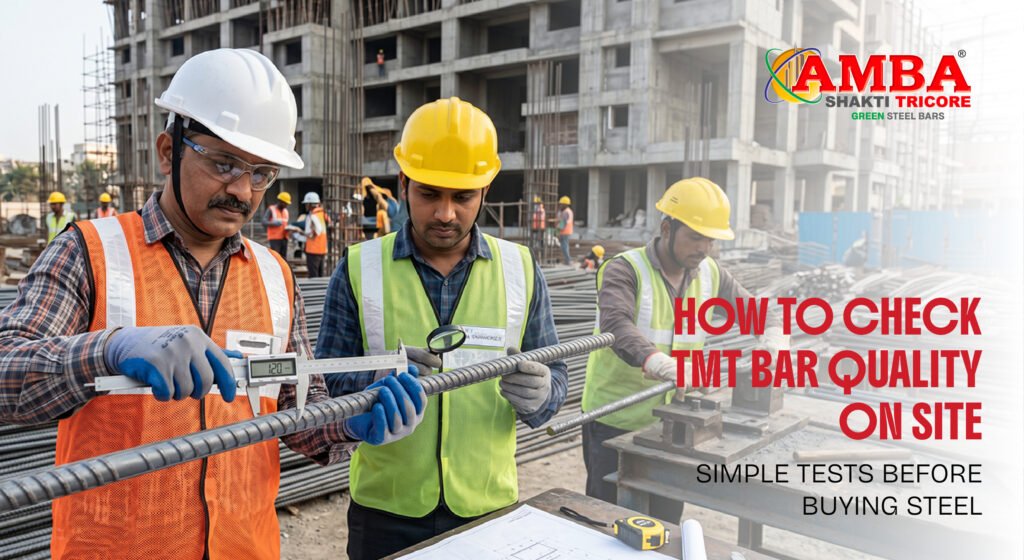
Steel decisions are rarely made on paper, they’re made on-site, often in a hurry, with stacks of bars lying in front of you. And that’s exactly where the difference between a strong home and a compromised one begins. Understanding a practical TMT bar buying guide and knowing how to do a quick TMT bar quality check can save you from long-term structural risks.
You don’t need a lab or complex tools to identify the best quality TMT bars in India. A few simple on-site observations can reveal a lot about the steel you’re about to invest in. These checks are widely used across construction sites and are effective enough to filter out substandard material.
Start with the basics – surface and finish. Good quality TMT bars have a uniform rib pattern and a clean surface without cracks or irregularities. The ribs (those raised patterns) are not just for design, they improve bonding with concrete. A proper TMT bar quality check begins by ensuring these ribs are consistent and well-defined.
Next comes the bend test, one of the simplest yet most telling checks. Take a bar and bend it to a certain angle, then try bending it back. High-quality steel will not develop cracks or fractures during this process. This flexibility indicates good ductility, a key property of the best quality TMT bars in India, especially important in areas prone to seismic activity.
Weight and length consistency is another quick indicator. Each bar should have a standard weight per meter as per IS specifications. If the bar feels unusually light, it may indicate lower density or compromised quality. Amba Shakti TMT bars are always tested to verify these physical parameters.
Here are a few simple on-site checks you should never skip:
While these tests help, the brand you choose still plays a crucial role. The top TMT bar brands quality is usually backed by consistent manufacturing, proper certification, and advanced technology. Trusted manufacturers like Amba Shakti ensure that every bar meets strict quality standards, reducing the need for doubt on-site.
Ultimately, a good TMT bar quality check is about awareness. It’s about not leaving such a critical decision to chance. When you combine basic on-site tests with a reliable TMT bar buying guide and choose from Amba Shakti Tricore, the best quality TMT bars in India, you’re not just buying steel, you’re securing the strength of everything that will stand on it.
You can perform basic on-site checks such as visual inspection, bend and rebend testing, weight verification, rust inspection, and checking brand embossing. These simple tests help identify whether the TMT bars meet basic quality standards before purchase.
Check for uniform rib patterns, consistent diameter, smooth surface finish, and the absence of cracks, bends, or manufacturing defects. Well-defined ribs improve bonding between steel and concrete.
The bend and rebend test helps evaluate the ductility and flexibility of TMT bars. High-quality TMT bars should bend without developing cracks or fractures, indicating their ability to withstand stress and seismic forces.
The best quality TMT bars are manufactured using advanced technology, comply with BIS standards, offer consistent strength and ductility, and come from trusted manufacturers with strong quality control processes.
Light surface rust is generally normal and does not significantly impact performance. However, deep corrosion, scaling, or severe rusting may indicate poor storage conditions and can affect the structural integrity of the steel.
Weight consistency helps verify whether the bars meet standard specifications. Underweight bars may indicate reduced steel content or manufacturing inconsistencies that can compromise structural performance.
Certified manufacturers follow strict quality standards, testing procedures, and compliance requirements. This ensures reliable performance, structural safety, and consistency across every batch of TMT bars.