
In modern metallurgy, the difference between average steel and high-performance steel lies in refining precision. As construction standards evolve, ensuring consistency, purity, and structural reliability has become critical.
At Amba Shakti, this precision is strengthened through the adoption of Ladle Refining Furnace (LRF) technology, enabling enhanced product quality through advanced refining. As one of the early adopters of LRF technology in North India, the focus has been on improving steel at its core.
LRF technology plays a defining role by enhancing the internal quality of steel before it is cast into billets, resulting in improved strength, corrosion resistance, and overall performance – key factors that directly impact TMT bar quality in India
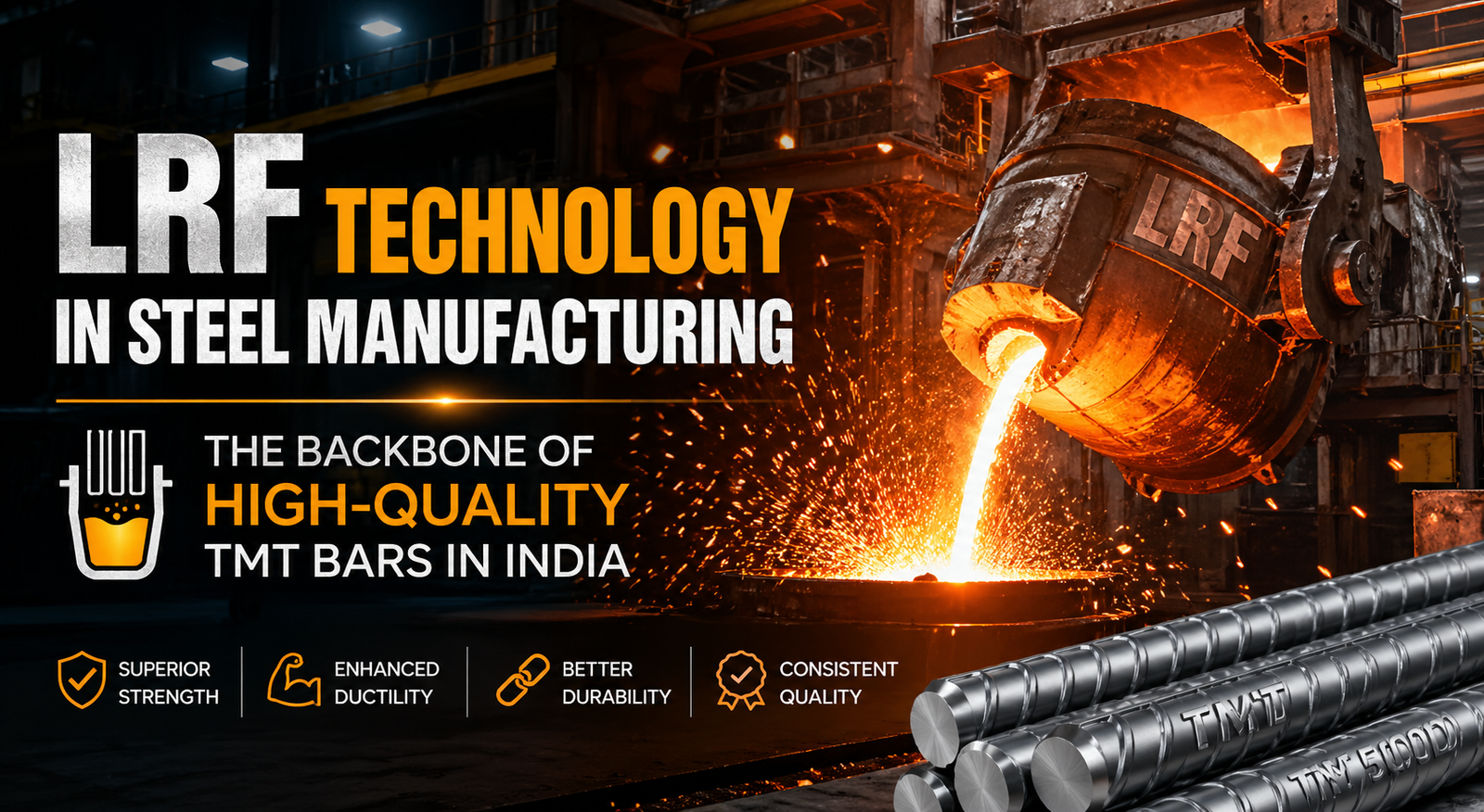
A Ladle Refining Furnace (LRF) is a secondary refining unit used after the primary steel-melting process. Once molten steel is produced in the induction furnaces, it is transferred into a ladle where further refinement takes place using graphite electrodes that enable precise alloy alterations to make the best quality steel.
The purpose of LRF is not to melt steel, but to refine its chemical composition and purity under controlled conditions.
With infrastructure projects becoming more demanding, expectations from reinforcement steel have increased. Steel manufacturing in India today, is no longer just about producing large quantities, but about delivering consistent and reliable performance.
LRF reduces impurities like sulphur and phosphorus, resulting in cleaner and tougher steel.
Precise composition control ensures an optimal balance between strength and flexibility, essential for handling both static and dynamic forces.
Cleaner steel is less reactive to environmental conditions, making it suitable for coastal regions, humid environments, and long-life infrastructure.
Uniform refining ensures reliable performance across batches, especially important for large-scale projects.
LRF-treated TMT bars offer improved weldability and bendability, making them easier to use on-site without compromising integrity.
As the industry moves toward more responsible practices, the focus is not only on strength but also on how steel is produced.
Amba Shakti Tricore TMT bars combine advanced LRF refining with a zero fossil fuel manufacturing approach, where electricity is sourced from captive solar and wind power plants. This significantly reduces dependence on coal-based energy and lowers the overall carbon footprint.
Importantly, this sustainability does not compromise performance. These TMT bars maintain the same strength, durability, and reliability while supporting environmentally conscious construction.
LRF technology has become a critical component in producing high-quality reinforcement steel. By improving chemical purity and ensuring consistency, it enhances the performance and reliability of TMT bars in India.
When combined with responsible manufacturing practices, as seen in Amba Shakti Tricore TMT bars, it also supports a more sustainable approach to construction.
In today’s evolving construction landscape, the real value lies in precision, consistency, and responsibility in how steel is made.
LRF (Ladle Refining Furnace) technology is a secondary steel refining process used after primary steel melting. It helps improve chemical composition, remove impurities, control temperature, and ensure uniform steel quality before billet casting.
LRF technology improves steel purity, chemical consistency, strength, ductility, and corrosion resistance. These improvements directly contribute to the production of high-quality TMT bars with reliable structural performance.
LRF reduces harmful impurities such as sulphur and phosphorus, creating cleaner steel with improved metallurgical properties. This helps enhance corrosion resistance and increases the service life of reinforced concrete structures.
LRF-refined steel offers better strength, ductility, weldability, workability, chemical consistency, and durability. These properties make it suitable for residential, commercial, industrial, and infrastructure construction projects.
Accurate chemical composition ensures that TMT bars achieve the required balance of strength, flexibility, and durability. Controlled metallurgy helps maintain consistent performance across every production batch.
Amba Shakti utilizes advanced Ladle Refining Furnace technology to improve steel purity, optimize alloy composition, and maintain uniform quality before billet casting. This process helps produce high-performance TMT bars with superior structural reliability.
LRF technology improves manufacturing efficiency and reduces quality variations, helping optimize resource utilization. When combined with renewable energy-powered steel production, it contributes to more sustainable and environmentally responsible steel manufacturing.