
For a long time, construction in India has been judged by one thing – strength. The stronger the structure, the safer it was considered. Today, that understanding is evolving.
With rising skylines, denser urban spaces, and greater seismic awareness, strength works alongside movement. Buildings today are expected to respond to dynamic forces with balance and resilience. That’s why earthquake-resistant TMT bars are shaping the future of construction in India.
In everyday conditions, a building stands composed. It carries load, distributes weight, and maintains stability.
During seismic activity, the ground shifts and the structure moves. Forces travel in multiple directions, creating dynamic stress across the framework. In these moments, performance depends on how materials respond under stress.
Steel that allows controlled flexibility supports the structure through this movement. It absorbs energy, adjusts, and maintains cohesion.
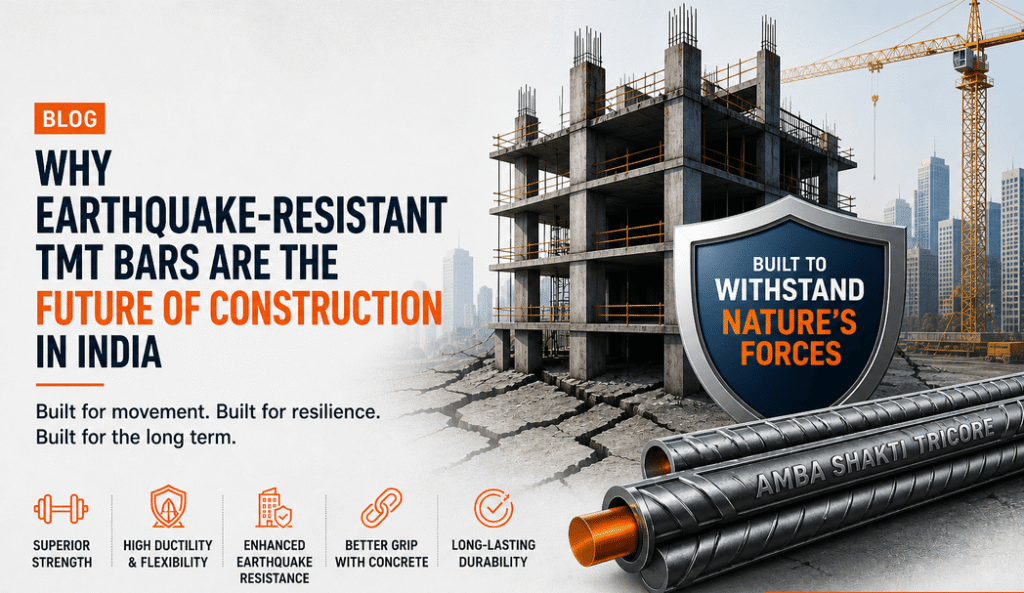
This is where Amba Shakti Tricore stands out. Its advanced core design creates a balance of strength and flexibility, allowing the bar to respond smoothly to seismic forces while maintaining structural integrity.
The most effective TMT bars in India, for earthquake zones, work in harmony with these forces, adjusting and stabilising the structure. With Amba Shakti, this performance is built into the material. The Tricore technology creates a refined balance between a strong outer layer and a resilient inner core, enabling the steel to absorb and distribute seismic energy efficiently.
At the same time, many regions fall within seismic zones, making resilience an essential part of design thinking.
The focus today has shifted toward a deeper question:
“How well does the structure perform under dynamic conditions?”
Materials like Amba Shakti Tricore play a key role here. Its ability to handle cyclic loading and continuous stress makes it highly effective during seismic activity, where forces move in waves and phases.
It Starts with How Steel is Made
The performance of a TMT bar begins inside the plant.
Consistency, purity, and structural precision shape how steel behaves in real-world conditions.
These directly influence performance during seismic activity, where reliability is essential at every stage. In Amba Shakti Tricore, these processes come together to create a microstructure that enhances fatigue resistance, allowing the steel to perform consistently through repeated seismic movements. The Direction We’re Heading: Construction in India is evolving with intent.
Built for movement.
Built for resilience.
Engineered for the long term.
Earthquake-resistant TMT bars have become a foundational choice in modern construction.
Because true strength reveals itself when structures adapt, respond, and continue to stand steady through changing conditions.
And in those moments, solutions like Amba Shakti Tricore quietly reinforce that confidence.
Earthquake-resistant TMT bars are specially engineered reinforcement bars designed to absorb and dissipate seismic energy during earthquakes. Their high ductility, elongation, and flexibility help structures withstand dynamic loads and reduce the risk of sudden failure.
India has several regions that fall under seismic zones, making earthquake-resistant construction essential. These TMT bars improve structural resilience, helping buildings withstand ground movement and seismic stress more effectively.
The key properties include high ductility, excellent elongation, flexibility, strong bonding with concrete, fatigue resistance, and consistent mechanical performance. These characteristics help structures absorb and distribute seismic forces safely.
Tricore technology creates a balanced microstructure with a high-strength outer layer and a ductile inner core. This design allows the TMT bar to absorb seismic energy, resist cracking, and maintain structural integrity during earthquakes.
Ductility allows reinforcement steel to bend and deform under stress without breaking. During an earthquake, this property helps buildings absorb energy and prevents sudden structural collapse.
Advanced manufacturing processes such as Thermex quenching, Ladle Refining Furnace (LRF) technology, and precision rolling improve strength, ductility, fatigue resistance, and consistency, all of which are critical for seismic performance.
Amba Shakti Tricore combines advanced Tricore technology, precision metallurgy, Thermex quenching, and stringent quality controls to deliver TMT bars with superior ductility, strength, and long-term structural reliability for earthquake-resistant construction.