How to Choose the Best TMT Bar for House Construction | Amba Shakti Steels

How to Choose the Best TMT Bar for House Construction | Amba Shakti Steels
Best TMT Bar for House Construction

Choosing the right materials is one of the most critical decisions when building a home, and selecting the best TMT bar for house construction plays a major role in ensuring long-term strength and safety. TMT (Thermo-Mechanically Treated) bars form the backbone of any structure, providing the necessary tensile strength to withstand loads, environmental stress, and time. With multiple options available, understanding what defines the best TMT bar for construction helps homeowners make confident, informed decisions

Understanding TMT Bar Grades for Construction: Fe 415, Fe 500 & Fe 550

When evaluating a TMT bar for house construction, the first factor to consider is the grade. Different TMT bar grades for construction, such as Fe 415, Fe 500, Fe 550, and Fe 600 determine the strength and flexibility of the bar. For most residential structures, Fe 500 and Fe 550 are ideal as they offer a strong balance between durability and ductility, which is crucial in areas prone to seismic activity. Choosing the correct grade ensures that your home remains structurally sound over time.

Key Features of the Best TMT Bar for Construction

Another important aspect is the quality of manufacturing. The best TMT bar for house construction is one that is produced using advanced processes that enhance strength, bendability, and corrosion resistance. This becomes particularly important in India’s diverse climate conditions, where humidity and temperature variations can affect the longevity of construction materials. A high-quality TMT bar for house construction will also offer better weldability, making construction smoother and more efficient.

Top TMT Bar Brands in India for House Construction

When looking at the top TMT bar brands in India, it is essential to consider brands that have built a reputation for consistency, nationwide presence, and reliable quality standards. The top pan-India TMT brands include:

  • Tata Tiscon – Known for exceptional durability and stringent quality standards.
  • JSW Steel (JSW Neosteel) – Famous for high ductility and earthquake-resistant properties.
  • Steel Authority of India Limited (SAIL) – A trusted government-backed brand known for raw strength and longevity.
  • Amba Shakti Steels Amba Shakti Steels TMT Bars are recognised for precision manufacturing, strong bonding strength, corrosion resistance, and consistent quality. With five manufacturing plants across Muzaffarnagar, Gwalior, Himachal Pradesh, Goa, and Sikandrabad, the brand has established a strong PAN India presence.
  • Jindal Steel & Power (Jindal Panther) – Highly regarded for tensile strength and advanced manufacturing technology.
  • Shyam Steel – Widely available across India and recognised for corrosion resistance and structural flexibility.

Important Factors to Consider Before Buying TMT Bars

To make the right choice, here are some key factors to consider while selecting a TMT bar for house construction:

  • Choose the right TMT bar grades for construction based on structural requirements
  • Ensure high tensile strength and flexibility for durability
  • Look for corrosion and fire-resistant properties
  • Verify certifications and adherence to quality standards
  • Opt for reliable names among the top TMT bar brands in India

Choose the Right TMT Bar for a Strong & Safe Home

Ultimately, selecting the best TMT bar for construction is not just about meeting technical requirements; it is about building a home that stands strong for generations. By choosing a trusted TMT bar for house construction and relying on proven brands like Amba Shakti Tricore TMT Bars, you ensure safety, resilience, and peace of mind for years to come.

FAQs

  1. Which is the best TMT bar for house construction in India?

    The best TMT bar for house construction should offer a balance of strength, ductility, corrosion resistance, and long-term durability. Most structural engineers recommend high-quality Fe500D or Fe550D TMT bars from trusted manufacturers that comply with BIS standards and maintain consistent quality.

  2. What TMT bar grade is best for residential construction?

    For most residential buildings, Fe500D TMT bars are considered the ideal choice because they provide excellent strength, flexibility, and earthquake resistance. Fe550D bars may also be used in projects requiring higher load-bearing capacity.

  3. Why is ductility important in TMT bars for house construction?

    Ductility allows TMT bars to bend and absorb stress without breaking. This is especially important in earthquake-prone regions where buildings experience dynamic loads and sudden movements.

  4. How do I choose the right TMT bar brand for my home?

    When selecting a TMT bar brand, consider manufacturing quality, BIS certification, corrosion resistance, strength, ductility, market reputation, and the availability of authorized distributors. Consistent product quality is more important than marketing claims.

  5. Are corrosion-resistant TMT bars necessary for house construction?

    Yes. Corrosion-resistant TMT bars help protect structures from rust-related damage, particularly in humid, coastal, and high-moisture environments. They improve the lifespan and durability of reinforced concrete structures.

  6. How can I verify the quality of TMT bars before buying?

    You can check for BIS certification, proper brand embossing, uniform rib patterns, standard weight specifications, and conduct basic bend tests. Purchasing from authorized distributors also helps ensure product authenticity.

  7. Why are Amba Shakti Tricore TMT Bars suitable for house construction?

    Amba Shakti Tricore TMT Bars are manufactured using advanced rolling technology, strict quality control, and precision engineering. They offer excellent strength, ductility, corrosion resistance, and bonding with concrete, making them a reliable choice for residential construction projects.
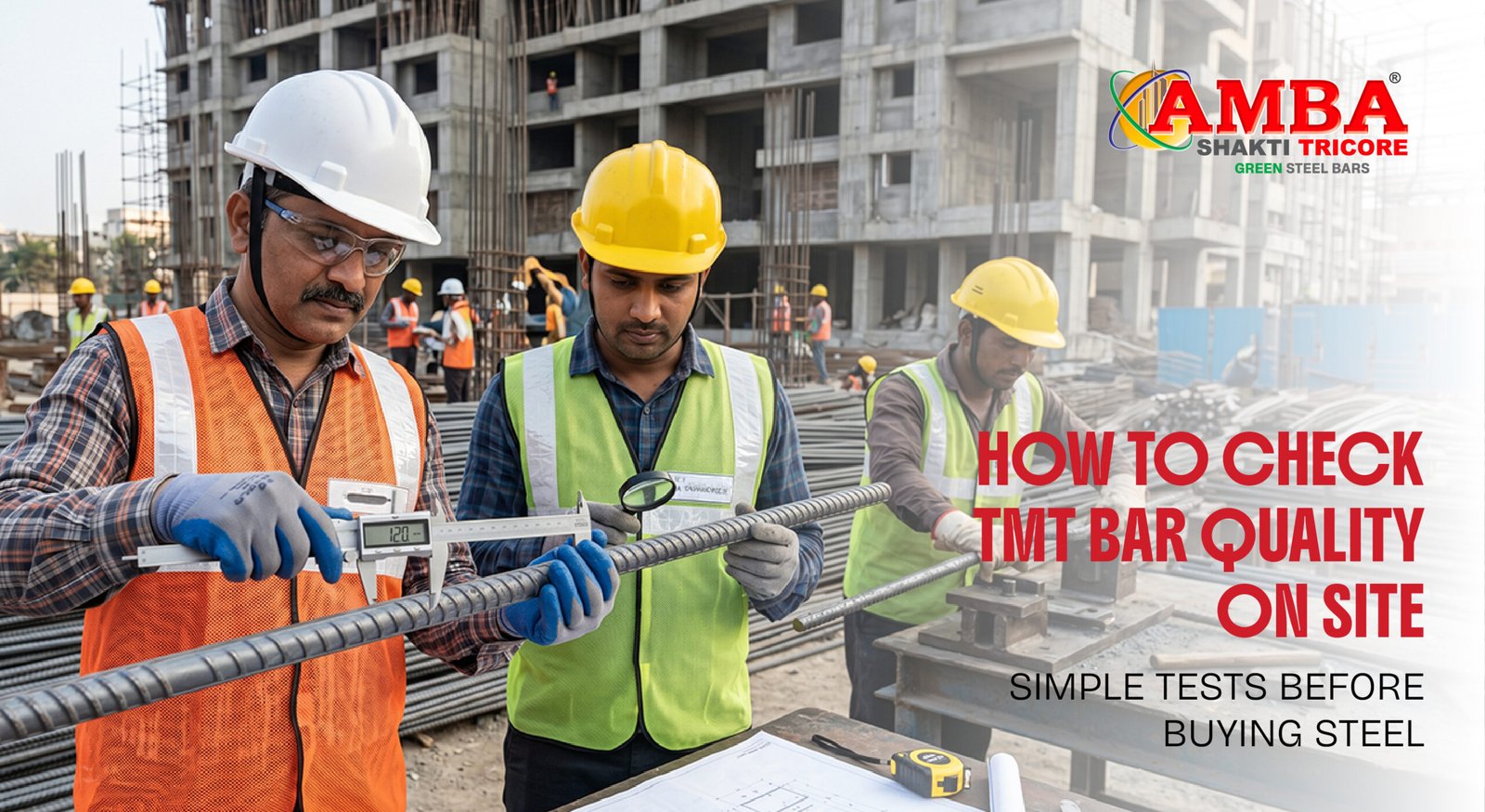
How to Check TMT Bar Quality on Site: Guide Before Buying Steel

How to Check TMT Bar Quality on Site: Guide Before Buying Steel

before Buying Steel | Amba Shakti Steels

Steel decisions are rarely made on paper, they’re made on-site, often in a hurry, with stacks of bars lying in front of you. And that’s exactly where the difference between a strong home and a compromised one begins. Understanding a practical TMT bar buying guide and knowing how to do a quick TMT bar quality check can save you from long-term structural risks.

Why TMT Bar Quality Matters in Construction

You don’t need a lab or complex tools to identify the best quality TMT bars in India. A few simple on-site observations can reveal a lot about the steel you’re about to invest in. These checks are widely used across construction sites and are effective enough to filter out substandard material.

Start with the basics – surface and finish. Good quality TMT bars have a uniform rib pattern and a clean surface without cracks or irregularities. The ribs (those raised patterns) are not just for design, they improve bonding with concrete. A proper TMT bar quality check begins by ensuring these ribs are consistent and well-defined.

Next comes the bend test, one of the simplest yet most telling checks. Take a bar and bend it to a certain angle, then try bending it back. High-quality steel will not develop cracks or fractures during this process. This flexibility indicates good ductility, a key property of the best quality TMT bars in India, especially important in areas prone to seismic activity.

Important Things to Check Before Buying TMT Bars

Weight and length consistency is another quick indicator. Each bar should have a standard weight per meter as per IS specifications. If the bar feels unusually light, it may indicate lower density or compromised quality. Amba Shakti TMT bars are always tested to verify these physical parameters.

Here are a few simple on-site checks you should never skip:

  • Visual Inspection – Look for uniform ribs and a smooth, defect-free surface
  • Bend & Rebend Test – Ensure the bar does not crack under stress
  • Weight Check – Compare with standard weight specifications
  • Rust Resistance – Slight rust is normal, but deep corrosion is a red flag
  • Brand Marking – Check for clear embossing of brand and grade

While these tests help, the brand you choose still plays a crucial role. The top TMT bar brands quality is usually backed by consistent manufacturing, proper certification, and advanced technology. Trusted manufacturers like Amba Shakti ensure that every bar meets strict quality standards, reducing the need for doubt on-site.

Ultimately, a good TMT bar quality check is about awareness. It’s about not leaving such a critical decision to chance. When you combine basic on-site tests with a reliable TMT bar buying guide and choose from Amba Shakti Tricore, the best quality TMT bars in India, you’re not just buying steel, you’re securing the strength of everything that will stand on it.

FAQs

  1. How can I check TMT bar quality on-site before buying?

    You can perform basic on-site checks such as visual inspection, bend and rebend testing, weight verification, rust inspection, and checking brand embossing. These simple tests help identify whether the TMT bars meet basic quality standards before purchase.

  2. What should I look for during a visual inspection of TMT bars?

    Check for uniform rib patterns, consistent diameter, smooth surface finish, and the absence of cracks, bends, or manufacturing defects. Well-defined ribs improve bonding between steel and concrete.

  3. Why is the bend and rebend test important for TMT bars?

    The bend and rebend test helps evaluate the ductility and flexibility of TMT bars. High-quality TMT bars should bend without developing cracks or fractures, indicating their ability to withstand stress and seismic forces.

  4. How can I identify the best quality TMT bars in India?

    The best quality TMT bars are manufactured using advanced technology, comply with BIS standards, offer consistent strength and ductility, and come from trusted manufacturers with strong quality control processes.

  5. Does rust affect TMT bar quality?

    Light surface rust is generally normal and does not significantly impact performance. However, deep corrosion, scaling, or severe rusting may indicate poor storage conditions and can affect the structural integrity of the steel.

  6. Why is weight consistency important when checking TMT bars?

    Weight consistency helps verify whether the bars meet standard specifications. Underweight bars may indicate reduced steel content or manufacturing inconsistencies that can compromise structural performance.

  7. Why should buyers choose certified TMT bar manufacturers?

    Certified manufacturers follow strict quality standards, testing procedures, and compliance requirements. This ensures reliable performance, structural safety, and consistency across every batch of TMT bars.

8mm vs 10mm TMT Bar: Best Size for Roof Slab Construction in India

8mm vs 10mm TMT Bar: Best Size for Roof Slab Construction in India

8mm vs 10mm TMT Bar | Amba Shakti Steels

A roof is the surface that silently carries weight, weather, and time. And somewhere within that structure lies a decision many overlook: 8mm vs 10mm TMT Bar.

What is the best size for roof slab construction?

It’s a small technical choice, but one that directly influences how your roof performs over the years. 

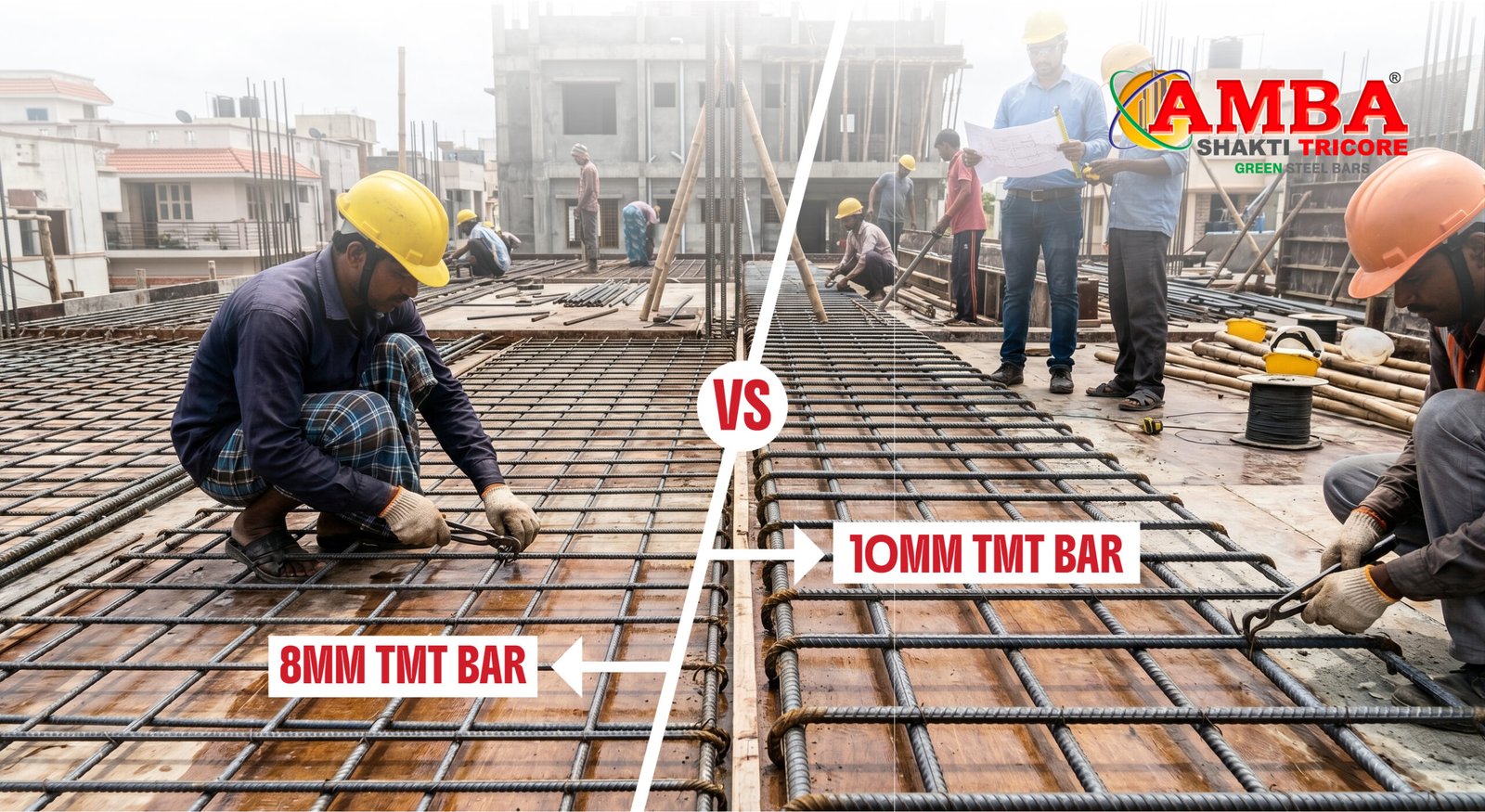
Let’s approach this differently. Instead of asking which is “better,” it’s more useful to understand where each fits. The discussion around 8mm vs 10mm TMT Bar is less about comparison and more about purpose. Every well-built slab uses a combination of reinforcements, each designed to handle a specific kind of stress.

8mm bars are typically used as distribution steel. In a TMT bar for roof slab setup, they help in controlling cracks, distributing load evenly, and maintaining structural balance. They are lighter, more flexible, and easier to place, making them ideal for secondary reinforcement.

10mm bars, on the other hand, serve as the strength. When selecting the best steel size for roof construction, these bars are widely used as the main reinforcement. They carry the primary load of the slab. Their higher diameter gives them the strength needed to ensure long-term durability.

To simplify the understanding of the best size for roof slab construction, here’s how they differ in practical use:

  • 8mm TMT Bars Used for distribution and temperature reinforcement Helps minimize surface cracks in slabs Suitable for lighter structural roles
  • 10mm TMT Bars Used for main reinforcement in roof slabs Provides higher load-bearing capacity Ensures structural strength and stability
  • Ideal Approach A combination of both ensures better performance 10mm bars handle load, while 8mm bars manage stress distribution Together, they create a balanced and durable slab

So, what truly defines the Best Size for roof slab construction in India? In reality, it’s not about choosing one over the other. The right TMT bar size for the roof slab is a calculated combination, where 10mm bars form the structural backbone, and 8mm bars support the slab by managing stress distribution. This combination helps improve durability and reduces the chances of cracks over time.

However, selecting the right size is only half the equation. The quality of steel matters just as much. Even the correct TMT bar size for the roof slab won’t deliver the expected performance if the steel lacks consistency and strength. This is why builders and engineers often prefer trusted manufacturers with a strong national presence.

Best TMT Bar Brands for Roof Slab Construction in India

Among the top TMT bar brands, quality leaders working across PAN India, Amba Shakti Steels has established itself as a dependable name in the industry. With five manufacturing plants located in Muzaffarnagar, Gwalior, Himachal Pradesh, Goa, and Secunderabad, Amba Shakti ensures consistent supply and quality standards across regions. Their advanced manufacturing processes, reliable strength, corrosion resistance, and strong bonding capabilities make Amba Shakti TMT a trusted choice for residential and commercial construction alike.

Alongside Amba Shakti, some other well-known companies operating across India include Tata Tiscon, JSW Steel, and Jindal Steel & Power, all recognized for their large-scale manufacturing and nationwide reach.

Factors like slab span, roof thickness, load conditions, and structural design should always guide your final decision. The conversation around 8mm vs 10mm TMT Bar ultimately comes down to smart planning and using the right materials in the right way.

In construction, strength is defined by how all components work together. And when The right 8mm vs 10mm TMT Bar combination is paired with trusted quality like Amba Shakti, You build reassurance that lasts for years.

FAQs

  1. Which is better for roof slab construction 8mm or 10mm TMT bars?

    Both 8mm and 10mm TMT bars serve different purposes in roof slab construction. 10mm TMT bars are generally used as the main reinforcement to carry structural loads, while 8mm TMT bars are used as distribution steel to control cracks and improve load distribution.

  2. Can 8mm TMT bars be used alone in roof slabs?

    No. In most roof slab designs, 8mm TMT bars are used as secondary reinforcement and are not typically sufficient as the primary load-bearing reinforcement. Structural engineers generally recommend combining 8mm and 10mm bars for optimal performance.

  3. Why are 10mm TMT bars commonly used in roof slabs?

    10mm TMT bars provide higher load-bearing capacity and structural strength. They act as the main reinforcement in roof slabs, helping the structure withstand dead loads, live loads, and long-term stress.

  4. What is the role of 8mm TMT bars in slab reinforcement?

    8mm TMT bars are used as distribution and temperature reinforcement. They help distribute loads evenly, minimize shrinkage cracks, and improve the overall stability of reinforced concrete slabs.

  5. What factors determine the right TMT bar size for roof slab construction?

    The ideal TMT bar size depends on slab thickness, span length, load requirements, building design, structural calculations, and local construction standards. Final reinforcement selection should always be based on engineering recommendations.

  6. Which TMT bar grade is suitable for roof slab construction?

    Fe500 and Fe500D TMT bars are widely used for roof slab construction because they offer an excellent balance of strength, ductility, and durability for residential and commercial buildings.

  7. Why is TMT bar quality important for roof slab construction?

    Even the correct bar size may not perform effectively if the steel quality is inconsistent. High-quality TMT bars ensure uniform strength, better bonding with concrete, corrosion resistance, and long-term structural durability.